
How to Start a Nail Technician Business in Nigeria in 2026: Complete Guide
How to Start a Nail Technician Business in Nigeria in 2026: Complete Guide
Forget the stories you've heard about oversaturation. The Nigerian beauty industry is a multi-billion naira engine, and the demand for skilled, professional nail technicians has never been higher. From the weekly owambe crowd in Lagos to the corporate professionals in Abuja, everyone wants perfectly manicured nails. If you have a passion for nail art and an entrepreneurial spirit, 2026 is the perfect year to turn that skill into a profitable business. This isn't just about painting nails; it's about building a brand, providing a top-tier service, and securing your financial future.
Overview & Key Takeaways
This guide provides a step-by-step blueprint for launching a successful nail technician business in Nigeria. We'll cover everything from getting the right training and creating a business plan to sourcing equipment, getting clients, and managing your money effectively.
- List Your Business on TrustAm Immediately: This is the fastest way to get discovered by clients, build trust with a verification badge, and secure payments with escrow protection.
- Invest in Quality Training: Your skills are your biggest asset. Professional training (costing ₦80,000 - ₦250,000) is non-negotiable for learning modern techniques and hygiene standards.
- Budget for a Startup Kit: A comprehensive starter kit with a quality UV lamp, e-file, and professional-grade products will cost between ₦150,000 and ₦400,000.
- Price for Profit, Not Just to Compete: Factor in your product costs, time, and skills. A full acrylic set in major cities can range from ₦10,000 to over ₦25,000.
- Protect Your Income with Escrow: Use a platform like TrustAm to ensure clients pay upfront. This eliminates the risk of no-shows and payment disputes after the service is done.
Nail Technicians on TrustAm
Book with escrow protection. If a job isn't done right, open a dispute and our team steps in.

Mannie nails
Service Provider · Nsukka
- Payment protected by escrow
- Money released only after you confirm the job

Mandy Glams
Service Provider · Uyo
- Payment protected by escrow
- Money released only after you confirm the job
Am in Anambra
Service Provider · Anambra state
- Payment protected by escrow
- Money released only after you confirm the job

OYN Nails
Service Provider · Yaba
- Payment protected by escrow
- Money released only after you confirm the job

Leemah's Nails
Service Provider · Ikeja
- Payment protected by escrow
- Money released only after you confirm the job
trills.nails
Service Provider · Lagos
- Payment protected by escrow
- Money released only after you confirm the job
The Billion-Naira Opportunity: Why Start a Nail Business in 2026?
The Nigerian beauty and personal care market is projected to grow significantly, making it a prime space for new entrepreneurs. A nail business offers high-profit margins and incredible flexibility. You can start small as a mobile technician, operate from home, or scale up to a full-fledged salon in cities like Port Harcourt or Ibadan. The key is professionalism and skill, which clients are willing to pay a premium for.
With Nigeria's high inflation rate (hovering around 25-30% in 2026), a skilled trade like this is a powerful hedge. It's a service that remains in demand despite economic pressures. Let's look at the potential earnings:
- Part-Time/Beginner: Focusing on weekends and evenings, you could realistically service 5-8 clients a week. At an average of ₦12,000 per client, that's ₦60,000 - ₦96,000 weekly, or ₦240,000 - ₦384,000 per month.
- Full-Time/Established: A dedicated technician with a steady client base can handle 3-4 clients per day. That's a potential income of over ₦700,000 per month, before accounting for product costs.
Step 1: Get Professional Training and Certification
To command premium prices and build a loyal clientele, you must invest in professional training from a reputable beauty school. Self-teaching from YouTube can only take you so far; proper training teaches you the science behind nail care, advanced application techniques, and most importantly, hygiene and sanitation protocols to keep your clients safe.
Look for academies in major cities like Lagos, Abuja, or Enugu that offer comprehensive courses. A good course should cover:
- Nail Anatomy & Health: Understanding the structure of the nail to avoid causing damage.
- Sanitation & Sterilization: Crucial for preventing infections and building client trust.
- Manicures & Pedicures: The fundamentals of nail care.
- Acrylic & Gel Applications: Mastering the two most popular types of extensions. This includes techniques like Gel-X, polygel, and sculpting.
- Nail Artistry: From simple designs to complex, intricate art that sets you apart.
- Client Consultation & Business Ethics: Learning how to manage client expectations and run your business professionally.
Expect to invest between ₦80,000 and ₦250,000 for a quality, multi-week certification course.

Step 2: Draft Your Nail Tech Business Plan
A business plan is your roadmap to success, helping you think through every aspect of your venture before you spend your first naira. It doesn't need to be a 50-page document, but it should clearly outline your strategy for turning a profit.
Your plan should include:
- Business Name: Choose a catchy, professional name and consider registering it with the Corporate Affairs Commission (CAC) for around ₦15,000 to protect your brand.
- Target Audience: Are you targeting university students in Ibadan, corporate women in VI, or the owambe crowd in Ikeja? Your target market determines your pricing, location, and marketing.
- Services & Pricing: Create a detailed menu. Research what other technicians charge. A good place to start is by looking at the prices listed by the best nail technicians on TrustAm in your city. This gives you real-time data on what the market can bear.
- Startup Budget: Be realistic about your costs. See the sample budget below.
- Marketing Strategy: How will clients find you? Your plan must include getting listed on platforms like TrustAm, which puts you directly in front of people searching for your service.
Sample Startup Budget (Home-Based/Mobile)
| Item | Estimated Cost (₦) |
|---|---|
| Professional Training | ₦150,000 |
| Comprehensive Starter Kit (Lamp, E-file, products) | ₦250,000 |
| Ring Light & Phone Stand (for content) | ₦35,000 |
| Business Registration (CAC) | ₦15,000 |
| Initial Marketing (e.g., social media ads) | ₦20,000 |
| Total Estimated Startup Cost | ₦470,000 |
Step 3: Sourcing Your Essential Equipment and Products
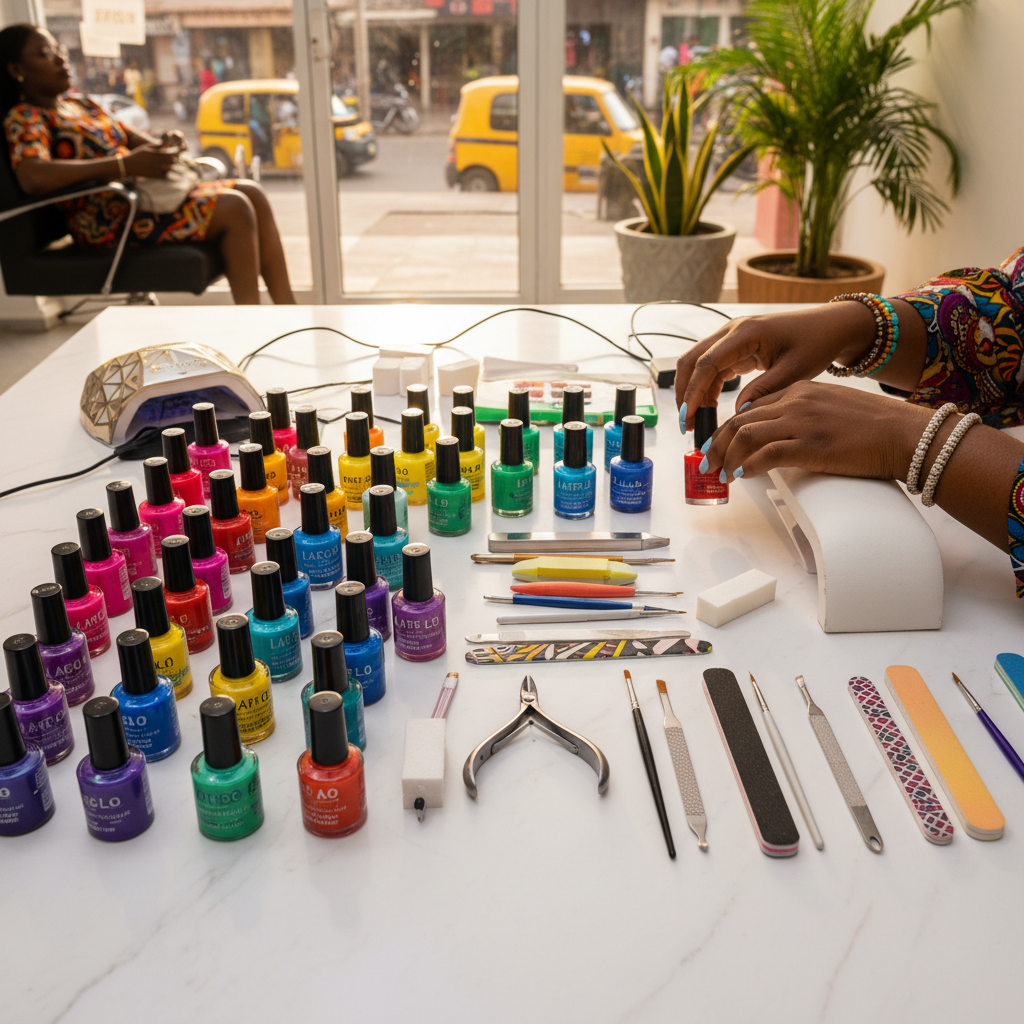
Using cheap, low-quality products is the fastest way to lose a client. They cause lifting, breaking, and can even lead to allergic reactions. Invest in professional-grade products from reputable suppliers. You can find these at major markets like Lagos Island or from specialized beauty supply stores online and offline.
Your essential starter kit must include:
- UV/LED Lamp (48w or higher): To properly cure gel products.
- Electric File (E-file): For efficient shaping, infills, and removal. Invest in a good one to avoid vibration and hand fatigue.
- Acrylic System: Quality monomer (liquid) and polymer (powder) in clear, pink, and white.
- Gel Polish System: A collection of popular colours, plus base coat, top coat, and builder gel.
- Nail Prep Essentials: Dehydrator, primer, files, buffers, and cuticle pushers.
- Sanitization Tools: Hospital-grade disinfectant (like Barbicide), a sterilization pouch system, and disposable files for each client.
- Nail Art Supplies: Brushes, rhinestones, glitter, and foils to let your creativity shine.
Step 4: Finding Your First Clients and Building Your Brand
Your skills are useless if nobody knows you exist. Marketing is crucial, and in 2026, a multi-platform approach is key. You need to be where your potential clients are looking, and that means combining social media with a powerful service marketplace.
Here’s your game plan:
- Create a Stunning Instagram Portfolio: This is your visual resume. Post high-quality photos and videos of your best work. Use relevant hashtags like #NaijaNails, #LagosNailTech, #AbujaNails.
- List Your Business on TrustAm: This is your most important step. While Instagram is great for showing off, TrustAm is where clients go to book and pay. Creating a free provider profile on TrustAm gets you in front of thousands of users actively searching for nail technicians in your city. A verified profile with clear pricing and good pictures builds instant credibility.
- Leverage Word-of-Mouth: Offer a small discount to your first few clients in exchange for honest reviews. One happy client can bring you five more.
- Build Trust with Payment-Backed Reviews: A review on TrustAm is more powerful than a comment on Instagram. Because it's tied to a completed, paid service, potential clients know it's 100% genuine. This is the ultimate social proof that helps you stand out from the competition.
Step 5: Managing Bookings and Payments Like a Pro
As a new business owner, the last thing you want to deal with is chasing clients for money or dealing with last-minute cancellations. The unprofessional back-and-forth of “Please send your account details” or hearing “My transfer is hanging” after a two-hour session can be frustrating and costly. This is where TrustAm becomes your business manager.
Using a platform with integrated payments protects your time and your income:
- Eliminate No-Shows with Escrow: When a client books you on TrustAm, they pay the full amount into a secure escrow account. The money is held safely until you've completed the service and they've confirmed it. This ensures you get paid, every single time. No more clients disappearing after you've bought products for their appointment.
- Look Professional with Invoicing: For corporate clients or bridal parties, you can generate and send professional invoices directly from the TrustAm app. It's clean, simple, and makes your business look serious.
- Simplify Payments with Request Links: Need to collect a deposit for a custom design? Simply generate a payment request link on TrustAm and send it to your client via WhatsApp or DM. They can pay instantly with a card, USSD, or bank transfer.
- Organize Your Schedule: Manage all your bookings in one place. The TrustAm app helps you keep track of your appointments, so you never have to worry about double-booking or forgetting a client.
Start Getting Clients on TrustAm
Ready to turn your passion into profit? List your nail technician services on TrustAm for free. Get discovered by thousands of clients, build trust with verified reviews, and secure your income with escrow-protected payments.
Create Your Free Provider Account →Join thousands of Nigerian service providers growing their businesses on TrustAm.
Frequently Asked Questions
How much do I need to start a nail business in Nigeria?
To start a small, mobile or home-based nail business in Nigeria in 2026, you should budget between ₦400,000 and ₦700,000. This covers professional training, a comprehensive high-quality starter kit, basic marketing, and business registration fees. Starting with a lower-quality kit can reduce initial costs but may lead to poor results and unhappy clients.
Is a nail technician business profitable in Nigeria?
Yes, a nail technician business is highly profitable in Nigeria if run professionally. With relatively low overheads for a home-based setup and high-profit margins on services, a skilled and busy technician can earn over ₦500,000 per month. Profitability depends on your skill level, pricing, and ability to attract and retain clients.
Do I need to register my nail business with CAC?
While you can start as an informal freelancer, registering your business name with the Corporate Affairs Commission (CAC) is highly recommended. It adds a layer of professionalism, protects your brand name from being used by others, and is a requirement for opening a corporate bank account, which helps in separating your personal and business finances.
How do I set prices for my nail services?
To set your prices, first calculate your cost per service (including products used, disposables, and a small amount for your tools). Then, research your competitors by checking prices of similarly skilled technicians in your area on platforms like Instagram and the TrustAm marketplace. Finally, factor in your skill level, the complexity of the design, and the time it takes to complete the service to arrive at a profitable price.
How can I get clients for my new nail business?
The most effective way to get clients is to create a profile on the TrustAm marketplace, where customers are actively searching for nail technicians. You should also build a strong portfolio on Instagram, encourage word-of-mouth referrals from your initial clients by offering excellent service, and offer an introductory discount for a limited time to attract your first bookings.
Book a verified Nails & Spa
Verified providers. Payment held safe until the job is done. Reviews only from real, paid bookings.
Download TrustAm
AI-powered budgeting, instant P2P payments, and escrow protection. Built for Nigeria.
Or get a download link sent to your phone
Chisom Anen
Founder and CEO of TrustAm. Building Nigeria's reputation marketplace for verified service providers. Reviews unlock only after real payments.
Disclosure: This article is published by TrustAm. Some links may direct to our own marketplace and products.
Sources & References
- Federal Inland Revenue Service— firs.gov.ng
- Corporate Affairs Commission— cac.gov.ng
- Small and Medium Enterprises Development Agency— smedan.gov.ng
- National Bureau of Statistics— nigerianstat.gov.ng
Related Services
Find trusted providers related to this article.
Related Articles



Free Tools You Might Find Useful
Try these free calculators and tools related to this article.