Nigeria's National AI Strategy and the Local Data Opportunity

Nigeria is stepping boldly into the artificial intelligence future. The National Artificial Intelligence Strategy (NAIS) outlines a vision for AI to drive economic growth and societal advancement. A key part of this strategy is the need for high-quality, locally relevant data. This presents a significant opportunity for Nigerians to contribute to and benefit from the burgeoning AI sector. Understanding this strategy and the data needs is crucial for both AI developers and individuals looking to participate.
Overview & Key Takeaways
This article explores Nigeria's National AI Strategy, highlighting the critical role of local data. It details the types of data needed, how it's collected responsibly, and the opportunities for Nigerians to contribute and earn. Key takeaways focus on the government's vision, data requirements, and the importance of ethical data practices.
- Nigeria's National AI Strategy prioritizes AI for economic and social development.
- High-quality, diverse, and locally relevant data is essential for training effective AI models.
- First-person video and Nigerian language speech data are in high demand for AI and robotics.
- TrustAm ensures responsible data collection through rigorous contributor verification, workplace registration, and consent procedures.
- Contributing data offers an opportunity for Nigerians to earn income and participate in the AI revolution.
Why Nigeria's AI Strategy Needs Local Data
Nigeria's National AI Strategy aims to position the country as a leader in AI adoption and innovation across Africa. A core pillar of this strategy, as outlined by NITDA, is the development and deployment of AI solutions that address local challenges and opportunities. However, AI models are only as good as the data they are trained on. For AI to truly serve Nigeria, it must be trained on data that reflects the nation's diverse languages, cultures, environments, and everyday activities. Generic, globally sourced data often fails to capture these nuances, leading to AI systems that are less effective or even biased when applied in a Nigerian context. This is where the opportunity for local data collection becomes paramount.

The National Artificial Intelligence Strategy (NAIS) emphasizes the need for data that is representative of Nigeria's vast population and its varied socio-economic landscape. This includes everything from everyday conversations in different Nigerian languages to the intricate movements of skilled tradespeople at work. Without this localized data, AI development in Nigeria risks replicating global biases and failing to serve the specific needs of its people. As stated in the National Artificial Intelligence Strategy, "AI has the potential to drive significant economic growth and improve the quality of life for all Nigerians." This potential can only be fully realised with data that truly represents Nigeria.
What Kind of Data Does AI Need From Nigeria?
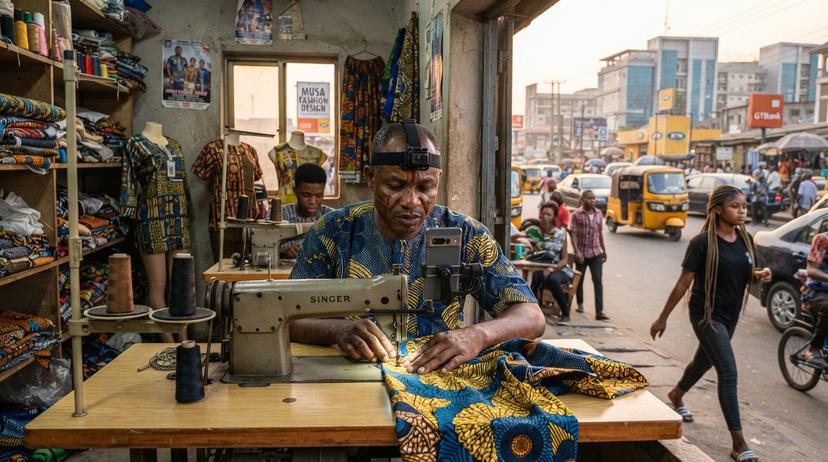
AI and robotics developers require a wide range of data to build intelligent systems. For Nigeria, the most sought-after data types are first-person (egocentric) video and Nigerian language speech. Egocentric video captures the world from the user's perspective, showing hands performing tasks, interactions with objects, and movements through environments. This is vital for training robots to perform physical tasks, for developing augmented reality applications, and for understanding human activity. Think of a mechanic in Ladipo Market fixing an engine, a tailor in Aba cutting fabric, or a chef in a buka kitchen preparing a meal – their actions, captured from their own viewpoint, are invaluable.
Speech data is equally critical. AI needs to understand and generate human language. For Nigeria, this means collecting audio recordings in English, Nigerian Pidgin, Yoruba, Igbo, Hausa, and many other local languages. These recordings should capture natural conversations, work instructions, and everyday speech patterns. The goal is to create AI systems that can communicate effectively and respectfully with all Nigerians. The need for such diverse datasets is highlighted by initiatives like Masakhane, which focuses on natural language processing for African languages.
Other data types, such as images of Nigerian environments, market scenes, and urban landscapes, are also valuable. Each data point helps to build more robust, accurate, and contextually relevant AI models. This is why TrustAm focuses on collecting data from a variety of trades and languages across Lagos. As noted in the "Why Skilled-Trade Video From Nigeria Matters for Embodied AI" blog post, data from skilled trades is particularly important for robotics.
Responsible Data Collection: TrustAm's Approach
Collecting data ethically and responsibly is non-negotiable. At TrustAm, we prioritize the safety, privacy, and fair compensation of our contributors. Our process begins with rigorous identity verification. Contributors must pass checks using their BVN or NIN against national records, alongside a live selfie matched to their ID. This ensures that only verified individuals participate. Payments are always made to a bank account or TrustAm account in the same name as the verified identity, with one person allowed only one account. This aligns with data protection principles, similar to those discussed in "ID Checks and Selfies in AI Data Work".

Workplaces are also vetted. Our field agents register each location in person, obtaining explicit consent from the business owner before any recording begins. This includes capturing a shop-front photo and a precise map pin within a defined area. For each recording, contributors must read a random three-digit code aloud while showing both hands at the start. We also record motion sensor (IMU) and GPS data alongside video. Automated checks for issues like black frames, frozen video, or stationary phones are performed. Crucially, every minute of footage is then reviewed by a trained human reviewer who approves or cuts the content, ensuring quality and relevance. Contributors are paid only for approved minutes, with clear reasons provided for any cuts, and an appeal process is available. This detailed review process is explained further in "From Raw Clip to Training Data: The Journey of One Recorded Minute".
Consent is paramount. Contributors read a consent statement on video in their own language before their first task. Bystanders' faces are blurred to protect their privacy, as detailed in "Face Blurring in AI Video Datasets". For conversation tasks, all speakers must give consent beforehand. Individuals can request the deletion of their data at any time, in line with data protection laws like the Nigeria Data Protection Act (NDPA) 2023, which mandates clear consent and data subject rights.
The Local Data Opportunity for Nigerians
Nigeria's National AI Strategy creates a tangible opportunity for individuals and businesses. By participating in data collection, Nigerians can contribute to the nation's technological advancement while earning income. TrustAm is actively recruiting recorders in Lagos for trades like tailoring, auto mechanics, phone repair, cooking, hair braiding, welding, carpentry, and market trading. The pilot program offers a payment rate of ₦4,750 per approved hour of recording, paid in naira to the recorder's own bank account.
This is not a get-rich-quick scheme; AI data collection is not a full-time salary. However, it provides a flexible way to earn money using a smartphone. Work opportunities become available in batches as buyers place orders. The Lagos pilot is currently collecting data, with plans to expand. For those interested in contributing, the process is straightforward: download the app, complete your profile, and await available tasks. TrustAm never charges a fee to join or for any equipment.
For AI and robotics teams, the opportunity is to access high-quality, ethically sourced data that is specifically tailored to Nigerian contexts. This data can significantly improve the performance and applicability of AI models in areas ranging from autonomous systems to natural language understanding. Companies can request a free 10-hour sample of data, recorded to their specific requirements, to evaluate its quality and relevance. This data is crucial for developing AI that truly serves the needs of the Nigerian market and beyond.
Frequently Asked Questions
Is recording videos for AI training data legitimate in Nigeria?
How can I ensure my data is used responsibly?
What if I don't have a smartphone?
Is this a full-time job?
What types of work are most valuable for AI training data?
Need AI training data from Nigeria?
Egocentric video of skilled work and Nigerian-language speech, collected to order. Email [email protected] or request a free 10-hour sample; a person replies within one working day.
Founder and CEO of TrustAm. Building Nigeria's reputation marketplace for verified service providers. Reviews unlock only after real payments.
Disclosure: This article is published by TrustAm Data, part of TrustAm Limited. Links to /data pages are our own data service.
Sources & References
- National Artificial Intelligence Strategy— ncair.nitda.gov.ng
- National Information Technology Development Agency (NITDA)— nitda.gov.ng
- Masakhane— masakhane.io
- NDP Act General Application and Implementation Directive (GAID) 2025— ndpc.gov.ng
- Ego4D: Around the World in 3,000 Hours of Egocentric Video— arxiv.org