Nigerian Pidgin speech data, recorded the way Naijá is really spoken.
Read prompts and natural conversation in Nigerian Pidgin (Naijá), with the English and local-language switching people really use. Consented, ID-checked speakers from different regions, transcribed to a written convention you agree with us.
Free 10-hour sample first. A person replies within one working day.
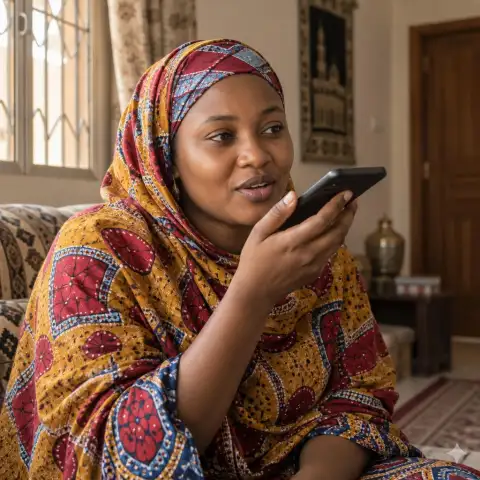
Nigerian Pidgin at a glance.
Spoken across Nigeria as a shared language between people of different first languages, strongest in the south (Lagos, the Niger Delta, Port Harcourt, Benin City) and widely used in markets, music, radio and online.
- Code
- pcm (ISO 639-3)
- Spelling
- No single official spelling; we agree a transcription guide with you (English-based or a phonemic Naijá convention) before recording
- Code-switching
- Frequent switches into English, Yorùbá, Igbo and others are transcribed as spoken and tagged per word on request
- Transcripts
- UTF-8, one per clip, with speaker turns and non-speech events marked
What speech models get wrong.
Spelling varies
The same word is written several ways online, so text normalisation and a consistent guide matter as much as the audio.
Close to English, not English
English ASR models often mis-hear Pidgin because many words look familiar but differ in sound, grammar and meaning.
Regional accents
Pidgin from Warri, Lagos and Port Harcourt differs in vocabulary and accent; a single-city set will not generalise.
Read prompts or conversation? Usually both.
For speech recognition (ASR)
Read prompts give you clean, aligned pairs; natural conversation gives you the speed, overlap and code-switching voice agents meet in real use. Most ASR buyers want both.
For text-to-speech (TTS)
For TTS we record fewer speakers for longer, from a phonetically balanced prompt list, in quiet rooms, with consent covering voice synthesis named explicitly.
A fair mix of real speakers.
- Speakers recruited by region of origin, age band and gender to a quota you set
- Metadata per clip: language, age band, gender, region, device, consent ID and version
- Every speaker ID-checked (BVN or NIN + live selfie) so one person cannot pose as many
- Market, transport, service and family-talk topics, not just read news text
How each clip is recorded and delivered.
- Audio
- WAV 48 kHz, 16-bit, mono per speaker (one track each in two-person sessions)
- Tasks
- Read prompts (your list or ours), natural two-person conversation, scripted service dialogues
- Transcripts
- UTF-8, one per clip, speaker turns and non-speech events marked; second-pass checks on every batch
- Metadata
- Language, age band, gender, region, device, consent ID and consent version per clip
- Consent
- Recorded in the speaker’s own language; voice synthesis (TTS) named explicitly when it applies
- Delivery
- Weekly batches over signed links, with a manifest and a QA report
Honest advice: what to try before buying.
Start with open research data
Academic Pidgin speech and text corpora exist on Hugging Face and in papers. They are a good place to start and to benchmark; we focus on licensed, consented, made-to-spec data when you need more.
African Next Voices
An open speech-data project led in Nigeria by Data Science Nigeria lists Nigerian Pidgin among its Nigeria languages, alongside Hausa, Igbo and Yorùbá.
Buyers usually ask.
How do you spell Pidgin in transcripts?
There is no single official spelling, so we agree a transcription guide with you before recording, and every transcriber follows it. We can deliver an English-leaning spelling, a phonemic Naijá spelling, or both.
Is Nigerian Pidgin the same as Ghanaian or Cameroonian Pidgin?
They are related but different. This page covers Nigerian Pidgin (pcm). Other West African pidgins can be discussed, but our speakers today are in Nigeria.
How do I order Nigerian Pidgin speech data?
Email [email protected] or use the request form with the hours, read/conversation split, speaker mix and transcript rules you need. We record a free sample of about 10 hours to your spec first. Pricing is quoted per approved hour after scoping.
How do speakers consent?
Each speaker passes an ID check and records consent in their own language before any paid task. If the data will be used for voice synthesis (TTS), that use is named explicitly. Speakers can withdraw from future deliveries.
More from TrustAm Data.
- Yorùbá speech dataLanguage code yo
- Igbo speech dataLanguage code ig
- Hausa speech dataLanguage code ha
- Nigerian-accented English speech dataLanguage code en
- ASR for African languagesUse case
- TTS voicesUse case
- Nigerian speech dataFive languages, one order
- African language dataLow-resource languages, consented
- Matching datasetsCollect-to-order listings
Tell us what you need. We send a free sample first.
Email [email protected] with the data type, hours, languages or trades, labels and format. Pricing is quoted per approved hour after scoping.